William Shakespeare Biography, Net Worth, Age, Birthday, Height
A complete William Shakespeare biography covering his early life, birthday, books, height, net worth, and the enduring legacy of the world's greatest dramatist.
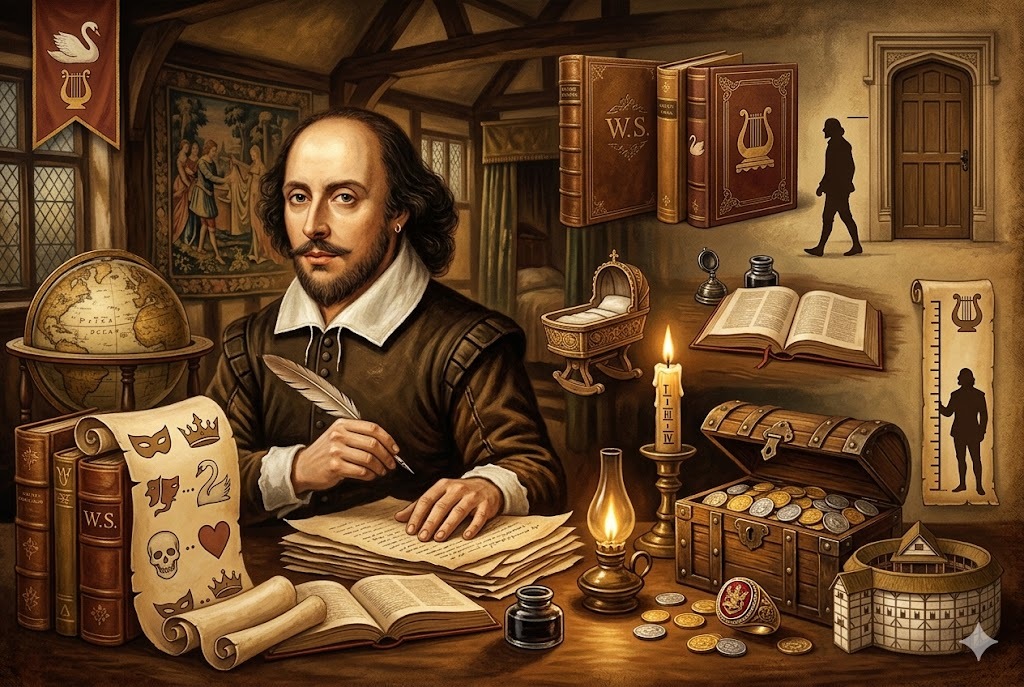
William Shakespeare is widely regarded as the greatest writer in the English language and the world's greatest dramatist. His works have been translated into every major language, performed more than those of any other playwright, and studied by millions of students and scholars across the globe. Whether you are a literature enthusiast or simply curious about this legendary figure, this complete William Shakespeare biography covers everything you need to know from his early life and birthday to his books, height, net worth, and enduring legacy.
| Detail | Information |
|---|---|
| Full Name | William Shakespeare |
| Born | April 26, 1564 (baptized) |
| Birthplace | Stratford-upon-Avon, Warwickshire, England |
| Died | April 23, 1616 |
| Age at Death | 52 years old |
| Nationality | English |
| Profession | Playwright, Poet, Actor |
| Spouse | Anne Hathaway (married 1582) |
| Children | Susanna, Hamnet, Judith |
| Height | Approximately 5 ft 7 in (170 cm) estimated |
| Net Worth (estimated) | Equivalent of $10–20 million USD today |
| Known As | The Bard of Avon |
William Shakespeare Born: Early Life and Birthday
William Shakespeare was born and baptized on April 26, 1564, in Stratford-upon-Avon, a quiet market town in Warwickshire, England. Scholars traditionally celebrate his birthday on April 23, 1564 — St. George's Day — though the exact birth date is not confirmed by any surviving record. The baptism entry from Holy Trinity Church remains the primary historical document that marks his arrival into the world.
He was the third child of John Shakespeare, a successful glove-maker and local alderman, and Mary Arden, the daughter of an affluent landowner. Growing up in a middle-class household, young William enjoyed relative comfort and access to an education that was simply unavailable to many children of his time.
He is believed to have attended the King's New School in Stratford, where he would have received a rigorous grounding in Latin, classical literature, rhetoric, and grammar. No direct records confirm his attendance, but the extraordinary depth of learning visible in his writing makes it difficult to imagine he was educated anywhere less demanding. Those early years in Stratford — the countryside, the market days, the local church, the stories told by neighbors — quietly filled the imagination of a boy who would one day rewrite the English language.
Read More: how to publish a book
William Shakespeare's Height
William Shakespeare's exact height is not recorded in any historical document. Based on what historians know about average height among Elizabethan Englishmen, along with analysis of skeletal remains from the period, most estimates place William Shakespeare at approximately 5 feet 7 inches tall, or around 170 centimeters. That would have put him at or slightly above average for an Englishman of his era and social class.
The portraits most commonly associated with Shakespeare — including the First Folio engraving by Martin Droeshout and the Chandos portrait — are head-and-shoulders compositions and offer very little in the way of useful physical clues. His height, then, remains an educated guess rather than a confirmed fact, though it has never stopped people from wondering about the man behind the words.
Marriage, Family, and Personal Life
At just 18 years old, William Shakespeare married Anne Hathaway, a woman eight years his senior who was 26 at the time of their wedding. The ceremony took place in November 1582 in Worcester. Their marriage produced three children. Their eldest, Susanna, was born in May 1583, and two years later, Anne gave birth to twins — a boy named Hamnet and a girl named Judith — in February 1585.
Tragically, his only son Hamnet died in 1596 at the age of just eleven. It was a grief that Shakespeare never publicly addressed, yet many scholars believe the loss left a quiet mark on some of his most sorrow-tinged writing in the years that followed.
Shakespeare spent the bulk of his professional life in London while his wife and daughters remained in Stratford. It was a long-distance arrangement that lasted for much of his career. By 1597, however, he had earned enough to purchase New Place, one of the finest and most spacious homes in Stratford-upon-Avon. He eventually retired there around 1613, living out his final years in the town where his story had first begun.
Read More: Professional Ghostwriter in United States
William Shakespeare: Career and Rise to Fame
Shakespeare's career as a playwright and author took shape in the late 1580s or early 1590s when he made his way to London and stepped into the city's busy and fiercely competitive theatrical world. He rose quickly. By the early 1590s, he was already being recognized as a writer of real talent — not just a jobbing playwright, but someone doing something genuinely new with the English language and with the possibilities of the stage.
He became a founding member of the Lord Chamberlain's Men, a theatrical company that would later be renamed the King's Men following the patronage of King James I in 1603. As both a shareholder and the company's primary playwright, Shakespeare had an unusual degree of creative and commercial control over his work. The company performed regularly at court and became the most admired and celebrated troupe in all of England.
In 1599, Shakespeare and his partners built the Globe Theatre on the south bank of the River Thames, an open-air playhouse that became the most famous stage in the world. It was here that many of his greatest works were first performed before audiences that ranged from working people standing in the yard to nobles and royalty seated in the galleries above. Shakespeare had a gift for writing that could speak to all of them at once, and that gift is a large part of what made him extraordinary.
William Shakespeare Books and Works
Over roughly 25 years of professional writing, William Shakespeare produced one of the most remarkable bodies of work in literary history. He wrote between 37 and 39 plays, depending on how certain collaborative works are attributed, 154 sonnets, and several longer narrative poems. Taken together, his output spans an estimated 884,647 words.
His plays fall into four broad categories. His tragedies are perhaps the most celebrated, including Hamlet, written around 1600, which remains one of the most performed and studied plays ever written. Othello, Macbeth, King Lear, Romeo and Juliet, and Julius Caesar all belong to this group of works that probe jealousy, ambition, love, power, and mortality with an unflinching honesty that has never lost its force.
His comedies, among them A Midsummer Night's Dream, Much Ado About Nothing, Twelfth Night, The Merchant of Venice, and As You Like It are equally enduring, built on wit, romantic confusion, wordplay, and the kind of warm, forgiving humanity that makes audiences laugh and feel understood at the same time.
His history plays, including the Henry IV plays, Henry V, Richard II, and Richard III, dramatize the turbulent story of England's medieval monarchy with a political intelligence that scholars and politicians have returned to for centuries. His late romances The Tempest, The Winter's Tale, Pericles, and Cymbeline, are stranger, more dreamlike works that circle themes of forgiveness, loss, and redemption.
Beyond the plays, his 154 sonnets stand as one of the greatest collections of poetry ever written in English, exploring love, time, beauty, and mortality in language of extraordinary precision and feeling. His narrative poem Venus and Adonis, published in 1593, was actually his first work to appear in print and became an immediate bestseller.
Read More: Spicy Romance Novels in 2026
The First Folio, published in 1623 by his fellow actors John Heminges and Henry Condell, collected 36 of his plays in a single volume seven years after his death. Without it, at least eighteen of those plays, including Macbeth, Twelfth Night, and The Tempest, might never have survived. It is considered one of the most important books ever printed.
William Shakespeare Net Worth
Putting a number on William Shakespeare's net worth means translating Elizabethan-era wealth into something a modern reader can make sense of, and historians have spent considerable effort doing exactly that.
By the time of his death in 1616, Shakespeare had built up a genuinely impressive fortune through several different sources. As a shareholder or "housekeeper" in the Globe Theatre, he received a cut of the box office every time the company performed there. As a full member and shareholder of the King's Men, he earned income from court performances and the company's ongoing theatrical work. He was also a canny investor in property. He bought New Place in Stratford in 1597, acquired a cottage in Chapel Lane, invested in local tithes, and held interests in agricultural land. His narrative poems, dedicated to the wealthy Earl of Southampton, are also believed to have brought him generous personal rewards.
When Shakespeare died, his estate was substantial. Adjusted for purchasing power and modern economic equivalents, most historians estimate that William Shakespeare's net worth at the time of his death would translate to somewhere between $10 million and $20 million USD in today's terms. That figure, remarkable as it is, says nothing of his literary estate. His plays and poems continue to generate enormous economic activity worldwide through film and television adaptations, theatrical productions, academic publishing, and the hundreds of thousands of tourists who visit Stratford-upon-Avon every year. By any honest measure, the cultural and commercial value of what he left behind is simply incalculable.
Shakespeare's Language and Literary Contributions
One of the most astonishing things about William Shakespeare as an author is the degree to which he shaped the English language itself. He is credited with coining or first recording more than 1,700 words that remain in common use today. Bedroom, lonely, generous, obscene, swagger, eyeball, addiction, eventful, lackluster, manager, and zany are just a handful of the words that entered the language through his pen. It is worth pausing on that. The next time someone calls a situation "lackluster" or talks about a colleague's "swagger," they are, without knowing it, quoting Shakespeare.
He also gave the language a treasury of phrases that have become so embedded in everyday speech that most people have no idea where they came from. "Break the ice," "heart of gold," "all that glitters," "a wild goose chase," "wear your heart on your sleeve," and "good riddance" are all his. So are "bedazzled," "cold-blooded," and "the green-eyed monster." The list runs to hundreds of expressions. No other writer in history has shaped the way English speakers think and talk as profoundly as Shakespeare did.
Read More: Outcome Based on a True Story
Death and Legacy
William Shakespeare died on April 23, 1616, in Stratford-upon-Avon. He was 52 years old. The cause of his death is not known with any certainty, though various theories have been proposed over the centuries. He was buried two days later in the chancel of Holy Trinity Church, the same church where, 52 years earlier, his baptism had been recorded. His gravestone carries a brief epitaph, believed to have been written by Shakespeare himself, that asks simply not to be disturbed.
In his will, he left his estate primarily to his eldest daughter, Susanna. To his wife Anne, he left — in what remains one of the most puzzling details in literary history — his "second-best bed." Scholars have debated what that bequest meant for four centuries and have never quite settled the question.
His reputation grew steadily after his death and exploded during the 18th and 19th centuries, when Romantic poets and critics elevated him to a status approaching the sacred. By the Victorian era, he had become a global symbol of English culture and literary achievement. Today, the Shakespeare Birthplace Trust cares for the historic sites connected to his life and welcomes more than half a million visitors each year to Stratford-upon-Avon. His works have been adapted into more than a thousand films and television productions, translated into over a hundred languages, and performed on every continent without interruption for more than four centuries. He is, by most measures, the second most quoted source in the English language after the Bible.
William Shakespeare: Key Achievements
Shakespeare's achievements during his lifetime were recognized at the very highest levels. In 1603, his theatrical company was taken under the direct patronage of King James I and renamed the King's Men — the most prestigious honor available to any theatrical troupe in England. In 1596, the Shakespeare family was granted a coat of arms, officially elevating William to the rank of gentleman, a social distinction he had long worked toward and his father had failed to secure a generation earlier. As co-founder and shareholder of the Globe Theatre, he helped build what became the most famous playhouse in history. The First Folio, the posthumous collection of his plays published in 1623, was added to the UNESCO Memory of the World Register in 2017, cementing its status as one of the most culturally significant objects in existence.
Fun Facts About William Shakespeare
Shakespeare is believed to have performed as an actor in his own plays, with some scholars suggesting he may have taken the role of the ghost of Hamlet's father. April 23, the date most associated with his birth, is also the date on which he died, 52 years later, a coincidence that has struck people as almost too neat to be accidental. His plays have been read aloud aboard the International Space Station. The Globe Theatre was faithfully reconstructed in 1997, just a few hundred meters from its original site on the south bank of the Thames, and continues to stage his work to this day. Scholars also believe that several of his plays were written in collaboration with other dramatists, including John Fletcher and possibly Christopher Marlowe, though the exact nature of those partnerships remains a matter of ongoing academic debate.
Read More: What Is Ghostwriting
Conclusion
William Shakespeare remains, more than four hundred years after his death, the most influential writer who ever lived. From his birth in the small English market town of Stratford-upon-Avon in 1564 to his extraordinary career as a playwright, poet, and author in London, his life story is as compelling as the characters he created. His books, from the towering tragedies of Hamlet and Macbeth to the tender sonnets and sparkling comedies, continue to shape literature, theatre, film, and language worldwide.
His net worth at the time of his death reflected a man of real substance and sharp business instincts. His height may be a matter of historical estimation, but the scale of what he contributed to human culture stands beyond any measurement. Whether you are reading this William Shakespeare biography for the first time or returning to it, one truth holds firm across the centuries: no writer has shaped the way we understand ourselves, our relationships, and our world quite like the Bard of Avon.